
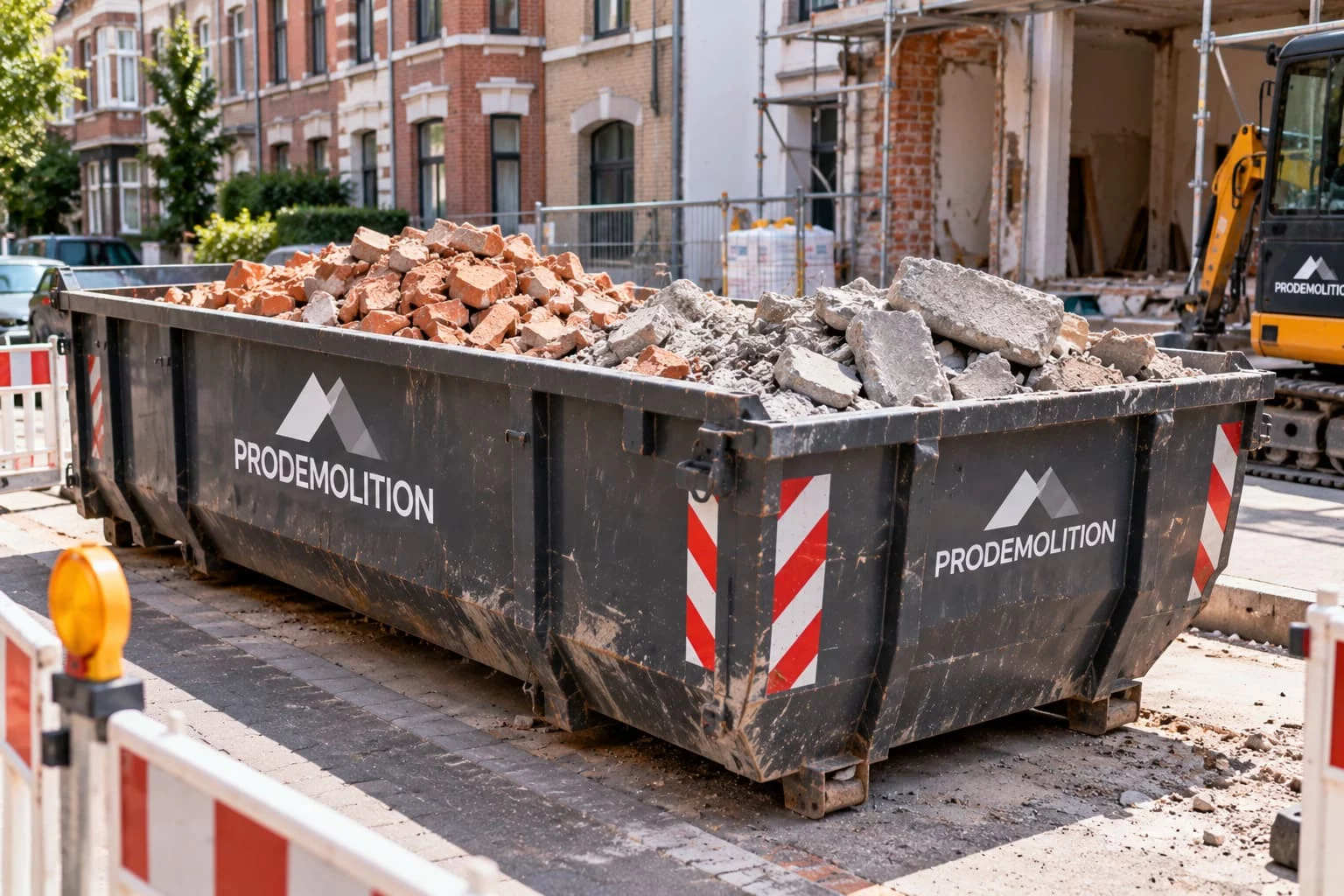
How much rubble will your demolition produce, and which skip do you need? Enter the elements removed, their area and thickness: the calculator estimates the in-place volume, the bulked volume (rubble takes up more space once broken), the weight and the recommended skip.
Rubble and skip calculator
Tell us what you are demolishing: we estimate the rubble volume, its weight and the right skip.
Heavy rubble: depending on weight, a smaller skip or several runs may be needed.
Request a quote with this result
Indicative estimate based on average densities and bulking factors. The final quote follows a free site visit.
How is it calculated?
In-place volume = area × thickness. Once demolished, materials take up more space: this is the bulking factor, about 1.4 to 1.8 depending on the material. Weight is estimated from the average density of each material (for example about 2.4 t/m³ for concrete and 1.8 t/m³ for brick).
Volume or weight: watch out for heavy rubble
Concrete, tiles and screed are very dense: a skip can reach its weight limit before it is full. In that case a smaller skip or several runs are planned. We advise you during the free visit.
See also: skip hire and rubble removal.
Related services
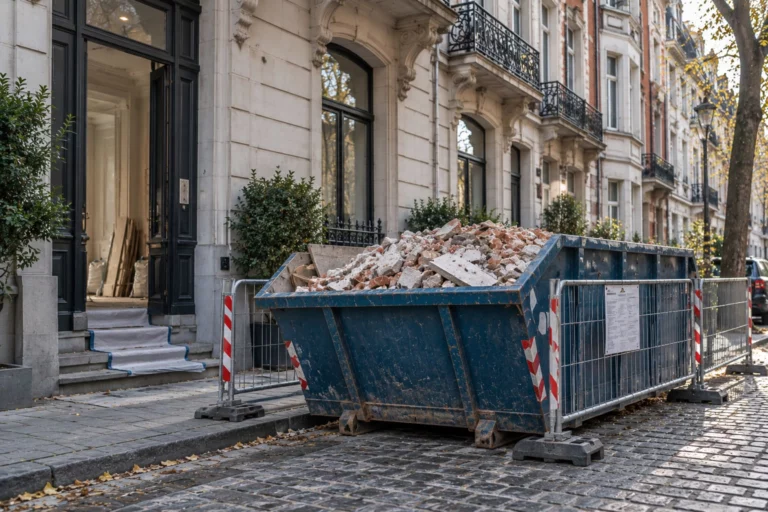 Skip hireProDemolition hires out waste skips from 6 to 30 m³ in Brussels and Belgium, applies for the municipal parking order and sets…
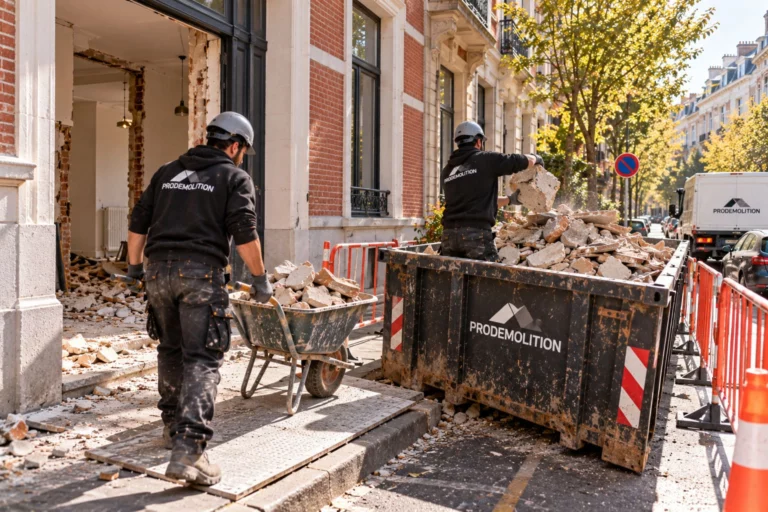 Rubble removalProDemolition loads, transports and removes rubble and site waste in Brussels and Belgium, with 6 to 30 m³ skips, municipal permits and…
 Free calculatorClearance estimatorFree estimator of the volume of a house clearance, room by room according to how full they are, with an indicative skip…
Frequently asked questions
What is bulking?
The increase in volume once a material is broken up: the pieces leave gaps between them, so the rubble volume exceeds the in-place volume.
Why does weight matter?
Skips also have a weight limit; with heavy rubble like concrete, weight is often the limiting factor.